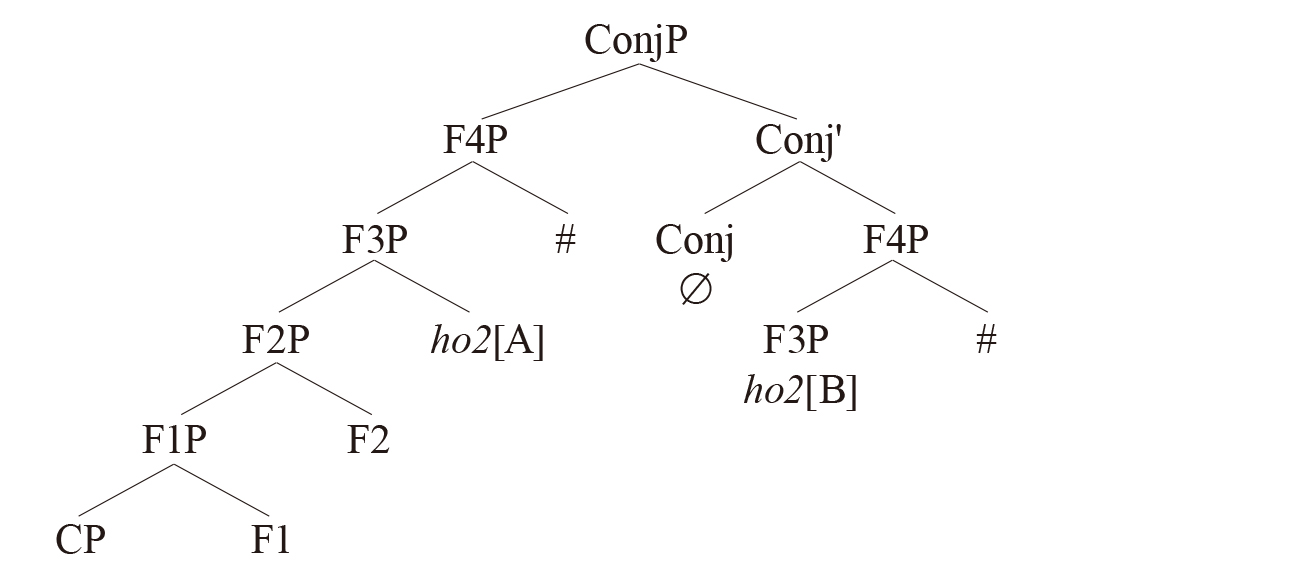
本文重新探討句尾成分“嗬”的句法特性,並主張粵語存在兩類“嗬”。儘管已有大量研究,包括Lam(2014)、Tang(2020)和Law et al.(2024),但針對如“咩嗬”等組合的語言直覺仍然莫衷一是。此外,Law et al.(2024)引入的涉及聽話人轉換的“嗬”尚未得到充分研究。為了解決這些問題,本文觀察“嗬”是否能與程度句尾助詞共現。結果顯示,不涉及聽話人轉換的“嗬”(“嗬1”)和涉及聽話人轉換的“嗬”(“嗬2”)有兩套不同的句法行為。本文主張“嗬1”是佔據F3P中心語的句末助詞,“嗬2”是一個通過空連詞與前述句子合併形成廣義聯合結構的代句詞。基於這個分析,本文重新審視以往的文獻。本文的分析比起以往文獻能夠更全面地覆蓋有關“嗬”的語言事實,從而提升對自然語言左緣結構的理解。
Abstract
This paper re-examines the syntactic properties of the sentence-final particle (henceforth, SFP) ho2 in Hong Kong Cantonese (henceforth, Cantonese). Despite studies such as Lam 2014, Tang 2020, and Law et al. 2024, variation persists among native speakers in their judgments regarding the acceptability of SFP clusters such as me1-ho2. Additionally, Law et al.’s (2024) preliminary observation that ho2 involves an addressee shift remains underexplored. To address these issues, this paper investigates whether ho2 can co-occur with the class of Degree SFPs (Tang 2015a). The results reveal that there are two distinct ho2s: one operating at the propositional level and the other at the speech act level. To capture this contrast, I propose that ho2[A] is an SFP occupying the head of F3P, which is one of the layers of the split-FP under the cartographic approach (Tang 2015b). On the other hand, ho2[B] is a pro-sentence merged with the antecedent sentence by an empty conjunction, forming a general conjunctive structure. The proposed account provides better empirical coverage compared to previous literature (Lam 2014; Law et al. 2024) and enhances our understanding of the nature of the left periphery in natural languages.
关键词
粵語 /
句末助詞 /
代句詞 /
確認助詞 /
左緣結構
Key words
Cantonese /
sentence-final particle /
pro-sentence /
confirmationals /
left-periphery
{{custom_sec.title}}
{{custom_sec.title}}
{{custom_sec.content}}
参考文献
Biberauer, Theresa, Anders Holmberg & Ian Roberts.2014. A syntactic universal and its consequences. Linguistic Inquiry 45(2). 169-225. https://doi.org/10.1162/LING_a_00153 (accessed 13 July 2024).
Büring, Daniel, & Christine A. Gunlogson.2000. Aren’t positive and negative polar questions the same? [Unpublished manuscript]. University of California, Santa Cruz.
Cheung, Hung-nin Samuel. 2007. A study of Hong Kong Cantonese grammar, revised edn. Hong Kong: The Chinese University of Hong Kong Press.
Cinque, Guglielmo.1999. Adverbs and functional heads: A cross-linguistic perspective. New York: Oxford University Press.
Grice, H. Paul.1975. Logic and conversation. In Donald Davidson (ed.), The logic of grammar, 64-75. Encino, CA: Dickenson Publishing Co.
Gyuris, Beáta.2017. New perspectives on bias in polar questions: A study of Hungarian -e. International Review of Pragmatics 9(1). 1-50.
Haegeman, Liliane & Virginia Hill. 2013. The syntacticization of discourse. In Raffaella Folli, Christina Sevdali & Robert Truswell (eds.), Syntax and its limits, 370-390. Oxford: Oxford University Press.
Heim, Johannes, Hermann Keupdjio, Zoe Wai-Man Lam, Adriana Osa-Gómez, Sonja Thoma & Martina Wiltschko.2016. Intonation and particles as speech act modifiers: A syntactic analysis. Studies in Chinese Linguistics 37(2). 109-129. https://doi.org/10.1515/scl-2016-0005 (accessed 23 April 2024).
Lam, Zoe Wai-Man.2014. A complex ForceP for speaker- and addressee-oriented discourse particles in Cantonese.Studies in Chinese Linguistics 35(2). 61-80.
Lau, Chaak Ming.2019. On the structure of sentential periphery from the perspective of Cantonese sentence-final particle aa3. Hong Kong: The Chinese University of Hong Kong dissertation.
Law, Jess. H.-K., Haoze Li & Diti Bhadra.2018. Questioning speech acts. In Uli Sauerland & Stephanie Solt (eds.), Proceedings of Sinn und Bedeutung 22(2). 53-70. Berlin: Leibniz-Centre Genral Linguistics.
Law, Jess. H.-K., Haoze Li & Diti Bhadra.2024. Force shift: A case study of Cantonese ho2 particle clusters. Natural Language Semantics 32. 315-357. https://doi.org/10.1007/s11050-023-09219-8 (accessed 7 June 2024).
Leung, Chung Sum.2005. Dangdai Xianggang Yueyu yuzhuci de yanjiu [A study on contemporary Cantonese particles in Hong Kong]. Hong Kong: City University of Hong Kong Press.
Matthews, Stephen & Virginia Yip.2011. Cantonese: A comprehensive grammar, 2nd edn. London: Routledge.
Miyagawa, Shigeru.2022. Syntax in the treetops. Cambridge, MA: MIT Press.
Rizzi, Luigi.1997. The fine structure of the left periphery. In Liliane Haegeman (ed.), Elements of grammar: Handbook in generative syntax, 281-337. Dordrecht: Kluwer.
Rizzi, Luigi.2004. The structure of CP and IP. Oxford: Oxford University Press.
Sheehan, Michelle, Theresa Biberauer, Ian Roberts & Anders Holmberg. 2017. The final-over-final condition. Cambridge, MA: MIT Press.
Speas, Peggy & Carol Tenny. 2003. Configurational properties of point of view roles. In Anna Maria Di Sciullo (ed.), Asymmetry in grammar, vol. 1, Syntax and semantics, 315-344. Amsterdam: John Benjamins Publishing Company.
Stalnaker, Robert.1978. Assertions. In Peter Cole (ed.), Syntax and semantics, vol 9, Pragmatics, 315-332. New York: Academic Press.
Sudo, Yasutada.2013. Biased polar questions in English and Japanese. In Daniel Gutzmann & Hans-Martin Gärtner (eds.), Beyond expressives: Explorations in use-conditional meaning, 277-297. Leiden: Brill.
Sybesma, Rint & Boya Li.2007. The dissection and structural mapping of Cantonese sentence final particles. Lingua 117(10). 1739-1783. https://doi.org/10.1016/j.lingua.2006.10.003 (accessed 5 May 2024).
Tang, Sze-Wing.2006. Yueyu yiwenju mo “sin” zi de jufa tedian [Syntactic properties of sin in Cantonese interrogatives]. Zhongguo Yuwen [Studies of the Chinese language] 312(3). 225-232, 287-288.
Tang, Sze-Wing.2015a. Yueyu yufa jiangyi [Lectures on Cantonese grammar]. Hong Kong: The Commercial Press.
Tang, Sze-Wing.2015b. A generalized syntactic schema for utterance particles in Chinese. Lingua Sinica 1(1). 1-23. https://doi.org/10.1186/s40655-015-0005-5 (accessed 2 July 2024).
Tang, Sze-Wing.2016. Zhitu lilun yu zhuci de lianhe jiegou shuo [Sentence-final particles as conjuncts under the cartographic approach]. Yuyan Yanjiu Jikan [Bulletin of linguistic studies] 16. 1-10.
Tang, Sze-Wing.2019. Xingshi Hanyu jufaxue [Formal Chinese syntax], 2nd edn. Shanghai: Shanghai Educational Publishing House.
Tang, Sze-Wing.2020. Cartographic syntax of performative projections: Evidence from Cantonese. Journal of East Asian Linguistics 29(1). 1-30. https://doi.org/10.1007/s10831-019-09202-7 (accessed 18 July 2024).
Wiltschko, Martina.2021. The grammar of interactional language. Cambridge: Cambridge University Press.
Wiltschko, Martina, Derek Denis & Alexandra D’Arcy.2018. Deconstructing variation in pragmatic function: A transdisciplinary case study. Language in Society 47(4). 569-599. https://doi.org/10.1017/S004740451800057X (accessed 16 July 2024).
Yip, Ka-Fai.2022. On Cantonese yes-no question particle aa4: Evidential bias and confirmation. Poster presented at the Language Diversity, Linguistic Theory and Cultural Identity in South Asia, Yale University, 29-30 April.
Zimmermann, Malte.2011. Discourse particles. In Claudia Maienborn, Klaus von Heusinger & Paul Portner (eds.), Semantics: An international handbook of natural language meaning, vol. 2, 2011-2038. Berlin & Boston: Mouton de Gruyter.
 PDF(665 KB)