Grammatical Multifunction via Causativity: Evidence from Morpheme Po55 in the Yanzhou (Jiande) Dialect

Vincent Ji-Xin Wang, Hua-Hung Yua

Studies in Chinese Linguistics ›› 2024, Vol. 45 ›› Issue (1) : 21-54.

PDF(907 KB)
PDF(907 KB)
Studies in Chinese Linguistics ›› 2024, Vol. 45 ›› Issue (1) : 21-54. DOI: 10.2478/scl-2024-0002

Grammatical Multifunction via Causativity: Evidence from Morpheme Po55 in the Yanzhou (Jiande) Dialect
  • Vincent Ji-Xin Wang1, Hua-Hung Yuan2
Author information +
History +

Abstract

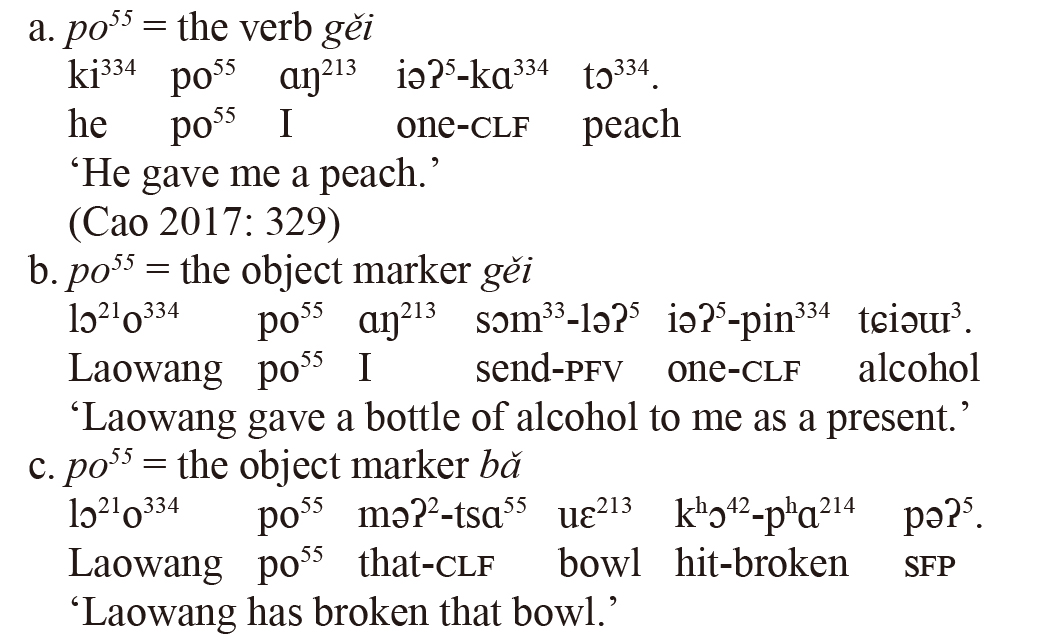
The morpheme po55 in the Yanzhou (Jiande) dialect functions as either a verb of giving or an object marker (Cao 2017). In the former case, po55 patterns with the ditransitive verb gěi in Mandarin Chinese, where the mode of transfer is semantically underspecified, while in the latter case, po55 marks distinct thematic roles of the post-po55 NP, akin to . The multifunction of po55 results from the grammaticalization pathway from verb of giving/helping to object marker, as defined by Chappell (2007). Through the extensive comparison with and -sentences in this paper, we argue that the post-po55 NP must be affected in a specific way and is always associated with the resultative state, due to the realization of the event denoted by the VP. By employing the linking framework in Randall 2010, we propose a unified treatment of po55 based on causativity, which ultimately leads to the conclusion that causativity constitutes the crucial component of the underlying Conceptual Structure of po55, while the morpheme po55 is lexicalized as a strict causative item, albeit its dual status in the grammar.

Key words

Yanzhou (Jiande) dialect / morpheme po55 / object marker / causativity / linking

Cite this article

Download Citations
Vincent Ji-Xin Wang, Hua-Hung Yua. Grammatical Multifunction via Causativity: Evidence from Morpheme Po55 in the Yanzhou (Jiande) Dialect[J]. Studies in Chinese Linguistics. 2024, 45(1): 21-54 https://doi.org/10.2478/scl-2024-0002

References

Bach, Emmon.1986. The algebra of events.Linguistics and Philosophy 9. 5-16.
Baker, Mark. C.1988. Incorporation: A theory of grammatical function changing. Chicago: University of Chicago Press.
Bisang, Walter.1992. Das Verb im Chinesischen, Hmong, Vietnamesischen, Thai und Khmer: Vergleichende Grammatik im Rahmen der Verbserialisierung, der Grammatikalisierung und der Attraktorpositionen. Tübingen: Gunter Narr Verlag.
Cao, Zhiyun.2017. Huiyu Yanzhou fangyan yanjiu [A study on the Yanzhou Hui dialects]. Beijing: Beijing Language and Culture University Press.
Chao, Yuen-Ren.1968. A grammar of spoken Chinese. Berkeley: University of California Press.
Chappell, Hilary.1992. Causativity and the ba-construction in Chinese. In Hansjakob Seiler & Walfried Premper (eds.), Partizipation: Das sprachliche Erfassen von Sachverhalten, 563-584. Tübingen: Gunter Narr Verlag.
Chappell, Hilary.2007. Hanyu fangyan de chuzhi biaoji de leixing [A typology of object-marking constructions: A pan-Sinitic view]. In Beijing Daxue Zhongguo Yuyanxue Yanjiu Zhongxin Yuyanxue Luncong Bianweihui [The editorial committee of Essays on linguistics, Centre for Chinese Linguistics, Peking University] (ed.), Yuyanxue luncong [Essays on linguistics] 36, 183-209. Beijing: The Commercial Press.
Chappell, Hilary.2015. Linguistic areas in China for differential object marking, passive, and comparative constructions. In Hilary Chappell (ed.), Diversity in Sinitic languages, 13-52. Oxford: Oxford University Press.
Chomsky, Noam.1986. Barriers. Cambridge, MA: MIT Press.
Davidson, Donald.1967. The logical form of action sentences. In Nicolas Rescher (ed.), The logic of decision and action, 81-95. Pittsburgh, PA: University of Pittsburgh Press.
Dowty, David.1979. Word meaning and Montague grammar: The semantics of verbs and times in generative semantics and in Montague’s PTQ. Dordrecht: Reidel.
Dowty, David.1991. Thematic proto-roles and argument selection.Language 67(3). 547-619.
Filip, Hana.2019. Aspectual class and Aktionsart. In Paul Portner, Klaus von Heusinger & Claudia Maienborn (eds.), Semantics: Noun phrases and verb phrases, 274-312. Berlin, Boston: Mouton de Gruyter. https://doi.org/10.1515/9783110589443-009 (accessed 12 March 2025).
Hashimoto, Mantaro J.1986. The Altaicization of northern Chinese. In John McCoy & Timothy Light (eds.), Contributions to Sino-Tibetan studies, 76-97. Leiden: Brill.
Heine, Bernd & Tania Kuteva. 2002. Word lexicon of grammaticalization. Cambridge: Cambridge University Press.
Hole, Daniel.2014. Dativ, Bindung und Diathese. Berlin & Boston: Mouton de Gruyter.
Huang, C.-T. James. 1982. Logical relations in Chinese and the theory of grammar. Cambridge, MA: Massachusetts Institute of Technology dissertation.
Huang, C.-T. James.1990. Complex predicates in generalized control. Unpublished manuscript, University of California, Irvine.
Huang C.-T.James, Yen-Hui Audrey Li & Yafei Li. 2009. The syntax of Chinese. Cambridge: Cambridge University Press.
Jackendoff, Ray.1987. The status of thematic relations in linguistic theory.Linguistic Inquiry 18(3). 369-411.
Jackendoff, Ray.1990. Semantic structures. Cambridge, MA: MIT Press.
Krifka, Manfred.1998. The origins of telicity. In Susan Rothstein (ed.), Events and grammar, 197-235. Dordrecht: Kluwer.
Larson, Richard K.1990. Double objects revisited: Reply to Jackendoff.Linguistic Inquiry 21(4). 589-632.
Levin, Beth & Malka Rappaport Hovav.2005. Argument realization. New York: Cambridge University Press
Li, Charles N.& Sandra Thompson. 1981. Mandarin Chinese: A functional reference grammar. Berkeley: University of California Press.
Li, Lan & Hilary Chappell.2013a. Hanyu fangyan zhong de chuzhishi he “ba”ziju, shang [Disposal and constructions in Chinese dialects (Part I)]. Fangyan [Dialect] 1. 11-30.
Li, Lan & Hilary Chappell.2013b. Hanyu fangyan zhong de chuzhishi he “ba”ziju, xia [Disposal and constructions in Chinese dialects (Part II)]. Fangyan [Dialect] 2. 97-110.
Li, Yen-Hui Audrey.1985. Abstract case in Mandarin Chinese. Los Angeles: University of Southern California dissertation.
Li, Yen-Hui Audrey.1990. Order and constituency in Mandarin Chinese. Dordrecht: Kluwer.
Liu, Feng-Hsi.1997. An aspectual analysis ofba. Journal of East Asian Linguistics 6. 51-99.
Lü, Shuxiang.1990. Beiziju, baziju dongci dai binyu [Verbs with objects in bei and ba sentences]. In Shuxiang Lü (ed.), Lü Shuxiang wenji, di’er juan, Hanyu yufa lunwenji [Lü Shuxiang collection, vol. 2, collection of papers on Chinese syntax], 200-208. Beijing: The Commercial Press.
Maienborn, Claudia.2011. Event semantics. In Claudia Maienborn, Klaus von Heusinger & Paul Portner (eds.), Semantics: An international handbook of natural language meaning, vol. 1, 802-829. Berlin & New York: Mouton de Gruyter.
Matisoff, James A.1991. Areal and universal dimensions of grammaticalization in Lahu. In Elizabeth Closs Traugott & Bernd Heine (eds.), Approaches to grammaticalization, vol. 2, Focus on types of grammatical markers, 383-454. Amsterdam: John Benjamins.
Norman, Jerry.1988. Chinese. Cambridge: Cambridge University Press.
Randall, Janet. H.2010. Linking: The geometry of argument structure. Dordrecht: Springer.
Sun, Chaofen.1995. Transitivity, theba construction and its history. Journal of Chinese Linguistics 23(1). 159-195.
Sybesma, Rint.1999. The Mandarin VP. Dordrecht: Springer.
Sybesma, Rint.2021. Voice and little v and VO-OV word-order variation in Chinese languages.Syntax 24(1). 44-77.
Talmy, Leonard.1976. Semantic causative types. In Masayoshi Shibatani (ed.), Syntax and semantics, vol. 6, The grammar of causative constructions, 41-116. New York: Academic Press.
van Valin, Robert D.1999. Generalized semantic roles and the syntax-semantics interface. In Francis Corblin, Carmen Dobrovie-Sorin & Jean-Marie Marandin (eds.), Empirical issues in formal syntax and semantics, vol. 2, Selected papers from the Colloque de syntaxe et sémantique de Paris (CSSP 1997), 373-389. The Hague: Thesus.
Vendler, Zeno.1967. Linguistics in philosophy. Ithaca, NY: Cornell University Press.
Wang, Huang.1984. “Ba”ziju he “bei”ziju [Ba sentences and bei sentences]. Shanghai: Shanghai Educational Publishing House.
Wang, Li.1954. Zhongguo yufa lilun [Theory of Chinese grammar]. Beijing: Zhonghua Book Company.
Yue-Hashimoto, Anne.1971. Mandarin syntactic structures.Unicorn 8. 1-149.
Zhao, Youxin.2012. Huiyu [Hui dialects]. In Zhenxing Zhang (ed.), Zhongguo yuyan dituji, di’er ban, Hanyu fangyan juan [Language atlas of China, 2nd edn, Chinese dialects], 146-151. Beijing: The Commercial Press.
Zhengzhang, Shangfang.1986. Wannan fangyan de fenqu, gao [Distribution of dialects in southern Wan, draft]. Fangyan [Dialect] 1. 8-18.
Zhengzhang, Shangfang.1987. Anhui nanbu de fangyan fenbu [Distribution of dialects in southern Anhui]. In Rong Li, Zhenghui Xiong, Zhenxing Zhang, Maoji Fu, Jun Wang & Bu Dao (eds.), Zhongguo yuyan dituji, diyi ban [Language atlas of China, 1st edn], B10. Hong Kong: Longman.
Zhengzhang, Shangfang.2002. Huiyu [Hui dialects]. In Jingyi Hou (ed.), Xiandai Hanyu fangyan gailun [Introduction to Modern Chinese dialects], 88-115. Shanghai: Shanghai Educational Publishing House.
PDF(907 KB)

Accesses

Citation

Detail

Sections
Recommended

/