Home Table of Contents

10 June 2025, Volume 45 Issue 1
    

  • Select all
    |
  • Ka Hin Ng
    Studies in Chinese Linguistics. 2024, 45(1): 1-19. https://doi.org/10.2478/scl-2024-0001
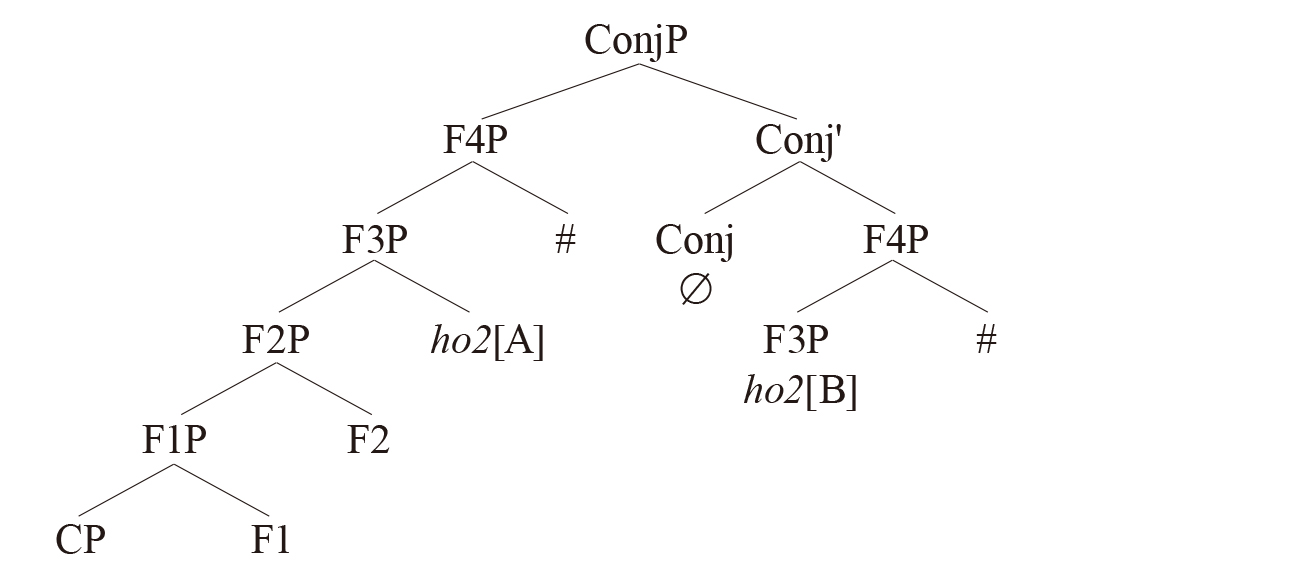
    This paper re-examines the syntactic properties of the sentence-final particle (henceforth, SFP) ho2 in Hong Kong Cantonese (henceforth, Cantonese). Despite studies such as Lam 2014, Tang 2020, and Law et al. 2024, variation persists among native speakers in their judgments regarding the acceptability of SFP clusters such as me1-ho2. Additionally, Law et al.’s (2024) preliminary observation that ho2 involves an addressee shift remains underexplored. To address these issues, this paper investigates whether ho2 can co-occur with the class of Degree SFPs (Tang 2015a). The results reveal that there are two distinct ho2s: one operating at the propositional level and the other at the speech act level. To capture this contrast, I propose that ho2[A] is an SFP occupying the head of F3P, which is one of the layers of the split-FP under the cartographic approach (Tang 2015b). On the other hand, ho2[B] is a pro-sentence merged with the antecedent sentence by an empty conjunction, forming a general conjunctive structure. The proposed account provides better empirical coverage compared to previous literature (Lam 2014; Law et al. 2024) and enhances our understanding of the nature of the left periphery in natural languages.
  • Vincent Ji-Xin Wang, Hua-Hung Yua
    Studies in Chinese Linguistics. 2024, 45(1): 21-54. https://doi.org/10.2478/scl-2024-0002
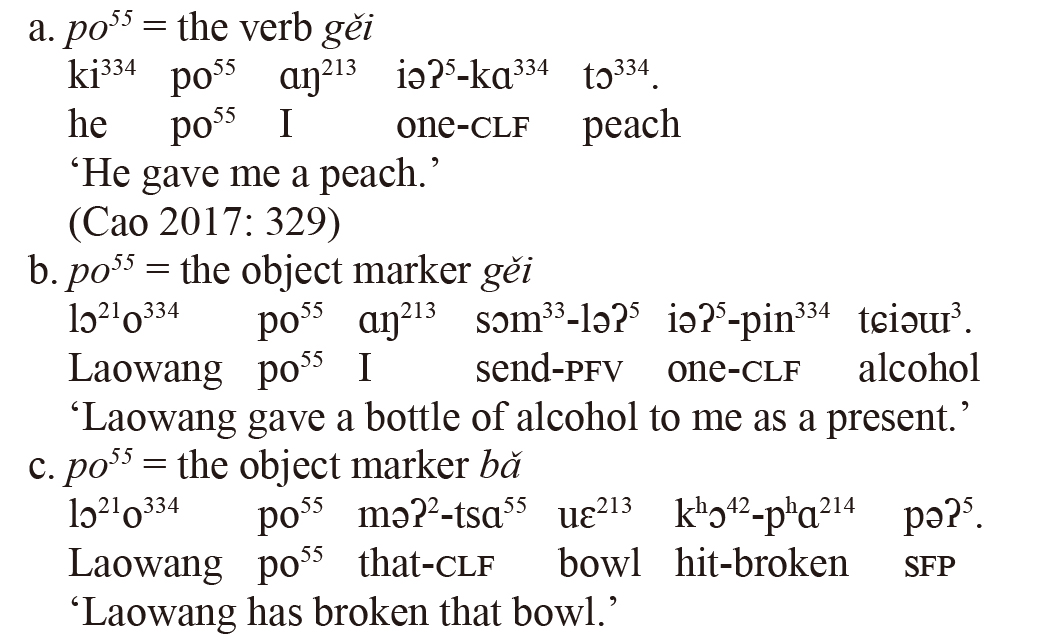
    The morpheme po55 in the Yanzhou (Jiande) dialect functions as either a verb of giving or an object marker (Cao 2017). In the former case, po55 patterns with the ditransitive verb gěi in Mandarin Chinese, where the mode of transfer is semantically underspecified, while in the latter case, po55 marks distinct thematic roles of the post-po55 NP, akin to . The multifunction of po55 results from the grammaticalization pathway from verb of giving/helping to object marker, as defined by Chappell (2007). Through the extensive comparison with and -sentences in this paper, we argue that the post-po55 NP must be affected in a specific way and is always associated with the resultative state, due to the realization of the event denoted by the VP. By employing the linking framework in Randall 2010, we propose a unified treatment of po55 based on causativity, which ultimately leads to the conclusion that causativity constitutes the crucial component of the underlying Conceptual Structure of po55, while the morpheme po55 is lexicalized as a strict causative item, albeit its dual status in the grammar.
  • Xiaotong Xu, Mitian Chen
    Studies in Chinese Linguistics. 2024, 45(1): 55-74. https://doi.org/10.2478/scl-2024-0003
    In English, a single sentence can be formed with only one core verb, while in Chinese, a serial verb construction is required to encode elements that are semantically equivalent to the English core verb. In English, verbs that involve no horizontal/vertical path, such as swirl, or even verbs that lack the concept of motion, such as roar, can directly enter a sentence when coupled with an element denoting the path. Yet in Chinese, the complement from a main movement verb is required. For example, verbs like xuánzhuǎn ‘swirl’ and hūxiào ‘roar’ can only function as additional elements to modify main movement verbs like fēi ‘fly’ or shǐ ‘drive’. Building on this observation, the present research investigates autonomous motion event sentences in Chinese and English, proposing that in both languages, characterizing an autonomous motion event requires the semantic conflation of its motion and path to express a concept of translational movement. The differences in semantic conflation patterns between Chinese and English can be attributed to the greater number and variety of prepositions in English. Some English prepositions, such as across, encode a directional path, while others, such as in, do not. Prepositions expressing a directional path could compensate for the absence of directional motion in non-horizontal/vertical movement verbs. However, Chinese has far fewer prepositions, and none encode a directional path, making movement verbs or directional path verbs indispensable. This study concludes that when a complement for movement is needed to characterize an autonomous motion event, prepositions expressing path perform this function in English, whereas in Chinese, the role is fulfilled by verbs.